How to Get Tripadvisor Reviews Without Breaking the Rules
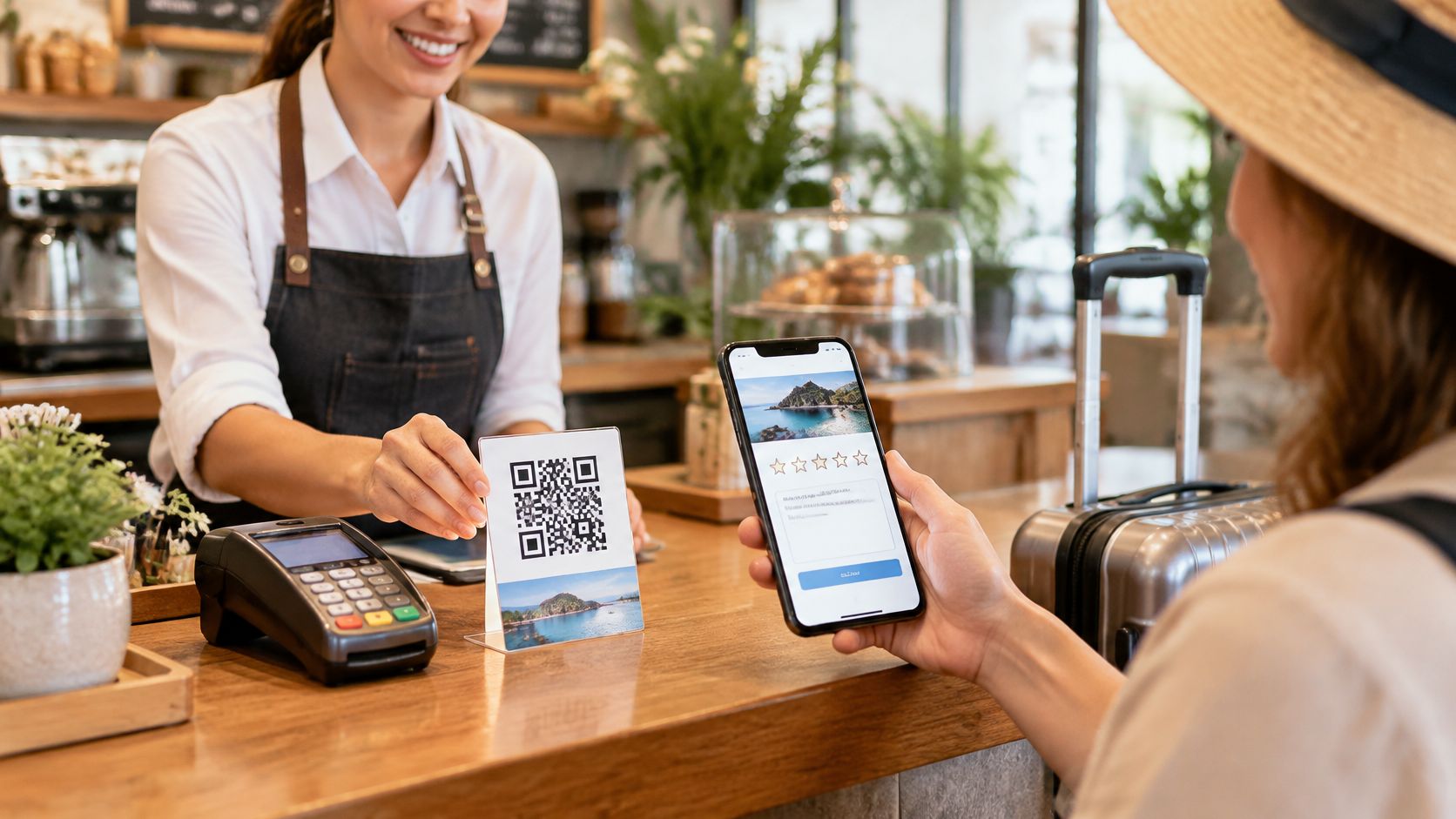
A guest returns a bike, puts a phone beside the payment terminal, and asks where to get lunch. The owner answers, hangs up the helmet, and watches another chance for feedback walk out the door. Later, an emailed review request competes with travel plans and a crowded inbox.
For owners wondering how to get Tripadvisor reviews, the practical fix isn't a clever pitch. It's a working review link, a neutral request for every guest, and a clear place to scan when the phone is already out. The process should make honest feedback easier, without steering the rating.
How to Set Up Your Review Link and QR Code
A QR code is only useful if it reaches the correct business and opens the right screen. Before printing cards, the owner needs to check the whole journey, from the camera scan to the Tripadvisor submission page.
Build the shortest working path
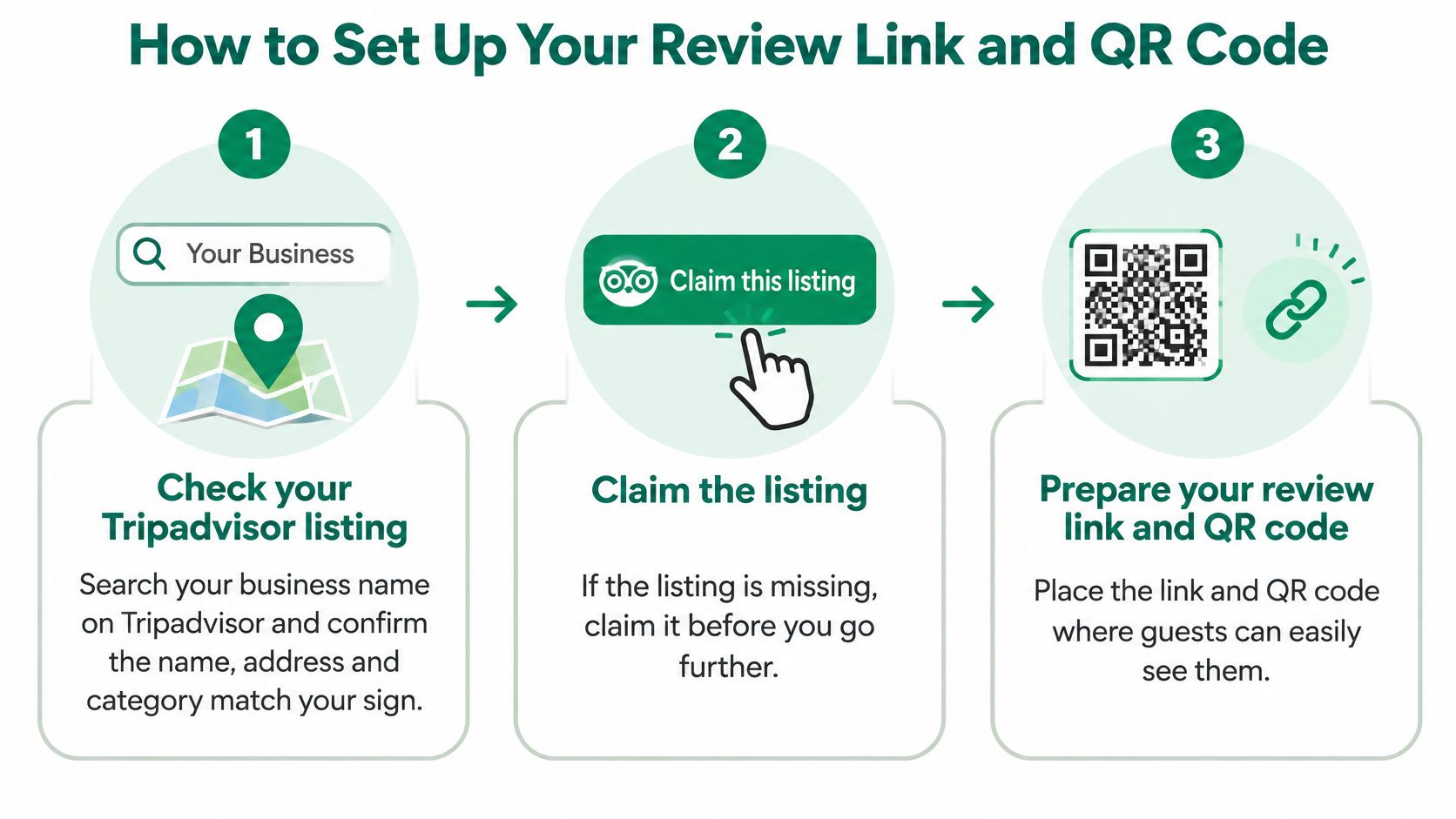
Check the Tripadvisor listing. The owner searches the business name and confirms that the name, address, and category match the business sign. An existing listing should be claimed; if no listing exists, the business needs to be added before a review link can be prepared.
Copy the direct review link. From the Tripadvisor business tools, the owner copies the review link supplied for that property. A general profile link leaves guests hunting for the review button, so the destination needs to be the submission screen.
Build and check the review page. HolaQR is a free QR review page with direct review buttons, automatic display in each guest's phone language, and a code that never expires. The owner types the business name or pastes a Linktree link, checks the automatically found logo, social accounts, and review links, then corrects anything that's wrong.
Add useful guest information. The page can include the website, Instagram, Facebook, opening hours, and practical links such as a menu or rental route. An owner already using a link page can follow the Linktree QR code setup guide, while keeping the Tripadvisor button easy to find.
Test the language and scan. The owner opens the page on a phone, then checks it on a phone set to another language. A normal camera scan should open the page in the browser without an app or account, although publishing a review still requires the guest's platform sign-in.
Prepare the printed pieces. Print-ready sticker, flyer, and table card files are included. Before ordering or printing, a staff member should scan the code and confirm that the Tripadvisor button opens the review window for the correct business.
Choose the tool for the job
A direct Tripadvisor link is the simplest choice for an email that asks only for Tripadvisor feedback. A multilingual page adds a choice screen, but it also gives international guests readable buttons and access to useful business information.
Print check: A successful camera scan isn't enough. The review button must reach the correct business's submission screen.
The code doesn't expire, and later link changes don't require replacement cards. Still, the owner should retest the destination after editing it. A permanent code can't compensate for an incorrect review link.
Write One Neutral Request for Every Guest
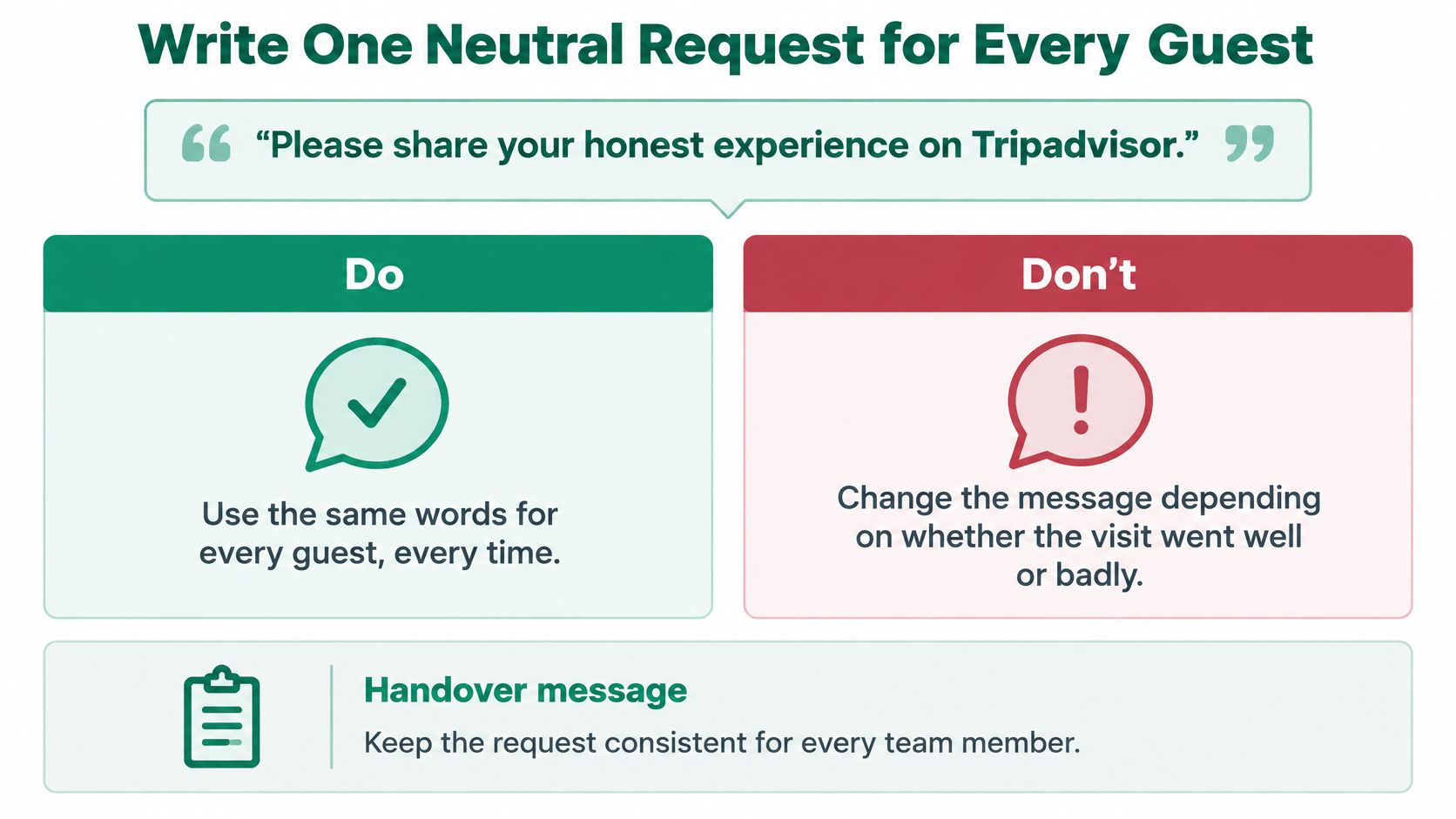
Please share your honest experience on Tripadvisor.
That sentence gives guests a clear invitation without telling them what to write. Every eligible guest should receive the same request, whether the visit went smoothly, involved a complaint, or ended with a refund discussion.
Keep the message consistent
A bike rental handover message can use this wording:
Thanks for riding with us today. Please share your honest experience on Tripadvisor.
The code or direct review link belongs beside the message. There's no need for a star graphic, a suggested rating, or a request for positive comments. Staff shouldn't add their own sales pitch after handing it over.
Tripadvisor's review guidance permits review requests but prohibits incentives, including discounts, free drinks, upgrades, raffles, gifts, and employee rewards tied to review volume; eligible reviews must describe a first-hand experience, be submitted within one year, and are limited to one review per business per visit.
The distinction matters at a busy counter. A staff member may think a small thank-you gift is harmless. Linking that gift to a review changes an ordinary request into an incentive.
Offer access, not pressure
Google's contribution policy also prohibits selectively seeking positive reviews and says merchants mustn't pressure customers to review while on the premises or request specific content. A card can be offered at departure without asking the guest to finish the review in front of an employee.
- Same invitation: Every guest gets access to the same review window, without a satisfaction question first.
- Guest control: The guest chooses whether to publish, what to say, and which rating reflects the visit.
- Own account: Guests sign in to Tripadvisor, Google, or Facebook as they normally would to write a review.
- No reward: The request stays separate from discounts, gifts, upgrades, and staff targets.
HolaQR sends guests to the same review window, never offers rewards for reviews, and never chooses which guests are asked. Staff still need a consistent handover habit so nobody starts selecting the most enthusiastic visitors.
The customer service reviews guide can support staff training, but the working script should stay short. A neutral sentence is easier for seasonal staff to use consistently than a speech.
Where, When and Start Today
A guest hands back the bike. The helmet goes on the hook. The phone is already out for payment, and the moment passes while the next customer asks about availability.
That handover is a useful place to offer the review code. The experience is fresh, the guest has finished using the service, and there's no need to search for the business later. The invitation should remain optional, especially when a queue is forming.
Match the request to the departure routine
In an independent 2015 study of 14,991 respondents conducted by Phocuswright on behalf of Tripadvisor, 87% of Tripadvisor users considered reviews important when booking restaurants and 81% when booking attractions, according to Tripadvisor's key research. Those findings concern planning decisions, not a guaranteed response rate for review requests.
Best moment to ask guests by business type
| Business type | Best moment to ask | Where to place the request |
|---|---|---|
| Bike or boat rental | Equipment return or handover | Counter card and handover message |
| Tour or activity | Right after the activity ends | Meeting point sign and post-tour message |
| Restaurant, café or bar | When the bill is paid | Table card and receipt area |
| Beach club | When guests leave the lounger or pay | Table card and reception desk |
| Holiday home or B&B | Checkout morning | Welcome folder and checkout note |
| Hotel | At checkout | Key card sleeve and checkout email |
| Salon, spa or shop | At payment or after the appointment | Counter card and receipt |
The physical placement needs to match what the guest is doing. A boat rental code belongs where keys and equipment are returned, not behind a safety notice. A restaurant table card must remain visible after plates and menus arrive.
For food businesses, the restaurant QR code guide offers a practical starting point for placing useful links beside the review option. The card shouldn't make guests guess whether they're opening a menu, paying a bill, or leaving feedback.
Run a simple counter test
Nothing needs to be printed before the first trial. The owner can display the code on a phone screen and let guests scan it as they leave. The page, QR code, and printable files are free.
A practical trial can run like this:
- Choose a moment: Equipment return, bill payment, or checkout becomes the standard invitation point.
- Use the existing message: The neutral sentence goes into the receipt, handover note, or checkout message.
- Keep access clear: The code faces the guest rather than sitting behind the till.
- Record the outcome: Staff note which placement was used and review the resulting submissions before changing the setup.
The page opens in each guest's phone language, so staff don't need to translate its review buttons. That doesn't mean every visitor will complete a review before leaving, and employees shouldn't wait over a guest's shoulder.
A cheerful handover can make the invitation feel natural, but mood must never decide eligibility. The useful trigger is the completed visit and available phone, not whether the guest seems likely to leave praise.
Penalties and Gating Mistakes That Hurt Your Listing
Most review problems start as counter habits, not elaborate fraud. An employee offers a small discount, asks only the guests who compliment the service, or tells an unhappy visitor to use a private form instead. Those shortcuts turn an honest feedback process into a selective one.
Spot the risky habits
Common mistakes, why they break the rules and safer fixes
| Mistake | Why it causes trouble | Safer fix |
|---|---|---|
| Discount or prize for a review | Counts as an incentive; reviews can be removed | Offer nothing and ask every guest the same way |
| Asking only happy guests | Selective solicitation of positive reviews | Ask every eligible guest at the same moment |
| Happy guests sent to Tripadvisor, unhappy guests sent to a private form | Review gating based on mood | Keep one neutral link and answer complaints separately |
| Asking for five stars or suggesting wording | Steers the content and rating | Use the neutral request for an honest experience |
| Staff, friends or family posting reviews | Connected-party reviews create an integrity problem | Seek feedback from genuine, independent guests using their own accounts |
| Several reviews requested for one visit | Duplicate requests conflict with the per-visit limit | Keep the request tied to the genuine visit, without seeking duplicates |
Review gating means deciding who reaches a public review platform based on their satisfaction. A preliminary happy-or-unhappy question can create that problem even when the owner describes it as customer care, as the Customer Alliance explanation of review gating makes clear.
The safer alternative isn't to ignore complaints. It's to offer help without removing the public review option.
Protect the listing, not just the rating
Tripadvisor's published enforcement explanation says incentive violations can lead to removal of the affected reviews, notification to the owner, and listing penalties depending on severity, with possible consequences ranging from a warning to a red badge and loss of award eligibility.
That makes a reward-based campaign a poor trade. The business risks its listing while collecting feedback shaped by an offer rather than a freely chosen response.
A private help channel can sit beside a public review button. It mustn't replace that button only for unhappy guests.
HolaQR doesn't filter guests or change their ratings; it only helps them leave a review. An owner can still undermine that neutral setup by selectively handing out the code, so staff conduct matters as much as the page.
A useful self-check is whether the owner could explain the request plainly to a Tripadvisor reviewer and show that every eligible guest receives it. If the explanation involves choosing likely supporters or hiding the public link from complainants, the process needs changing.
Timing, Follow-Up and Tracking Results
The working rhythm is straightforward: offer the request when the experience ends, allow the guest to leave, and use a restrained follow-up rather than repeated messages. A single reminder is a sensible operating limit, not a reason to chase someone who hasn't responded.
Tripadvisor's Review Express tool provides automated reminders and campaign reporting. Where those reports are available, the owner can use them instead of guessing whether messages reached guests or led to action.
Track the path, not just the total
A weekly sheet should separate channels and invitation moments. Useful columns include:
- Request details: Date, channel, departure moment, and requests sent or offered.
- Guest actions: Recorded clicks and submitted reviews, where attribution is available.
- Owner response: Replies sent, response time, and the share of new reviews answered.
- Business outcome: Subsequent inquiries, kept separate from review totals.
A click isn't a completed review. If a tool doesn't connect submissions to individual requests, the sheet should label attribution as unknown rather than treating every new review as a proven campaign result.
Tripadvisor cites Medallia findings that properties responding to more than 50% of social-media reviews had occupancy growth 6.8 percentage points higher than lower-response properties, in its review management guidance. That's an association, not proof that replying will produce the same result for a rental counter or restaurant.
Use the results to change a specific action
In a hypothetical tour-operator trial, staff could log meeting-point invitations over a week, compare recorded clicks with published reviews, and reply promptly to new feedback. The owner could then test a post-tour message without changing the wording at the same time.
Questions and complaints can use the page's WhatsApp button, which sends questions and bookings directly to the business without booking-platform commission. The public review option must remain available regardless of the conversation.
At month-end, the useful question is which channel and moment produced the clearest evidence of completed reviews, and what should change next.
Start with a checked Tripadvisor listing and a tested review destination. Create a free HolaQR page, display the code on a phone at the next departure, and give every eligible guest the same neutral invitation. Print the counter or table cards only after staff have confirmed that the scan reaches the correct review window.