Spa Comment Cards: How to Set Up and Use Them
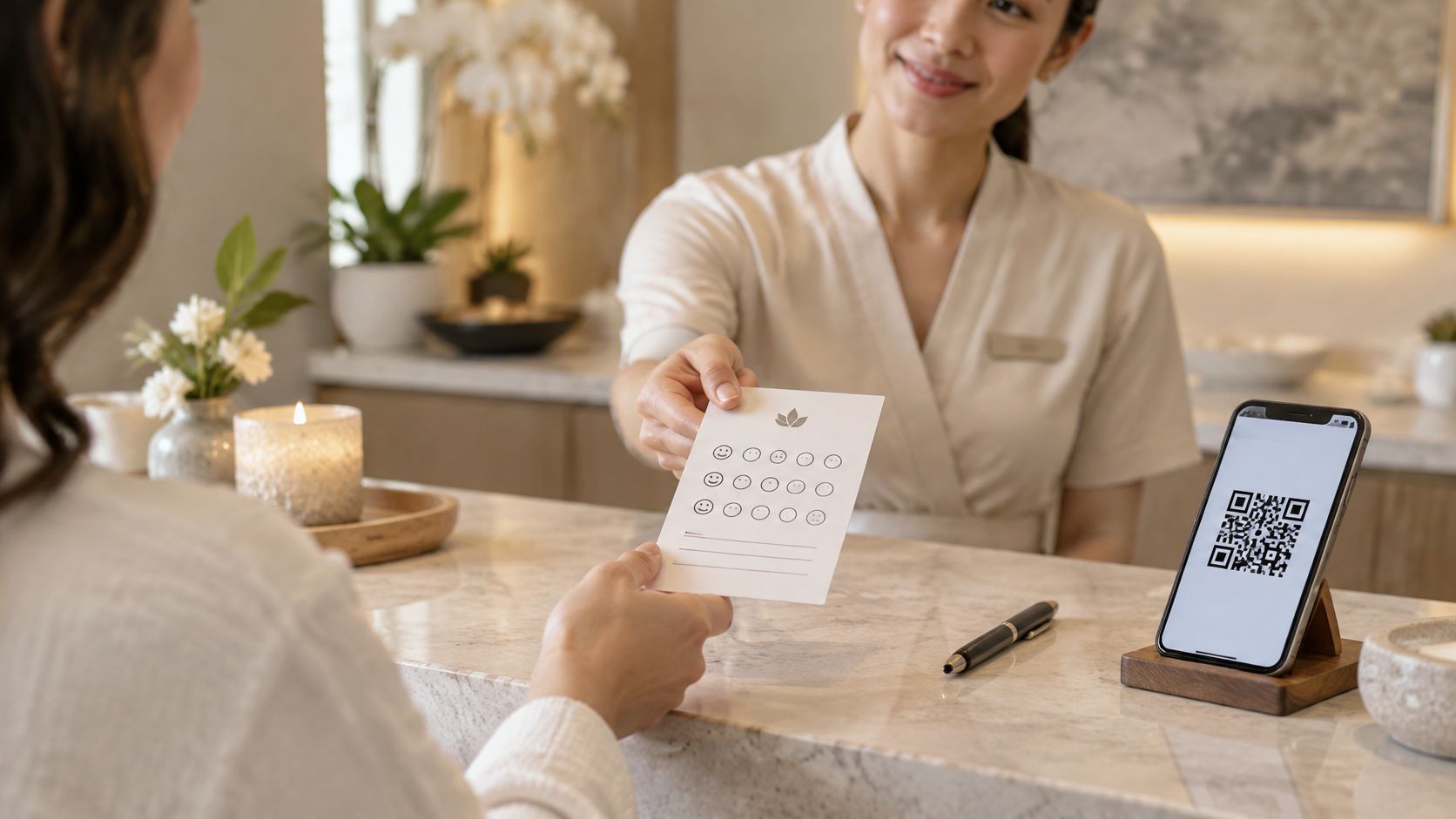
A guest has finished a treatment. Reception is taking payment, another guest is waiting, and the therapist needs the room ready. Asking whether everything was fine gets a polite nod. Later, a complaint appears about an unexpected charge or a lack of privacy.
Spa comment cards should make those concerns easier to raise privately, without turning checkout into an interview. The same principle applies to bike and boat rentals, tours, restaurants and holiday homes: ask a clear question, offer a discreet way to answer, and give someone responsibility for acting.
Questions That Get Honest Answers on a Comment Card
A general question about how the visit went often produces a general answer. A comment about poor service leaves a manager guessing. A comment about extras not being explained before booking gives reception something specific to check.
Sensitive concerns need particular care. Consumer findings reported by Spa Business found that 25% of spa visitors reported anxiety about body confidence, 27% worried about unexpected costs, and 71% were primarily concerned that the spa would be too busy. Pricing, crowding and privacy deserve direct questions. Body-related questions don't belong on the card.
Card prompts by area
| Area | Question to print | Answer format |
|---|---|---|
| Treatment quality | How well did your therapist explain the treatment? | Rating 1-5 plus optional comment |
| Waiting and crowding | How long did you wait before your treatment started? | Minutes or 1-5 rating |
| Privacy and comfort | Did you feel your privacy was respected in the treatment room? | Yes, no or not sure, plus optional comment |
| Pricing transparency | Were prices and extras explained before you booked? | Yes or no, plus optional comment |
| Phone use and noise | Was phone use or noise in the spa a problem for you? | Yes or no, plus optional comment |
| Cleanliness | How clean did the treatment room and changing area feel? | Rating 1-5 |
| Staff courtesy | How friendly and helpful was our team at check-in? | Rating 1-5 |
Choose five or six prompts, rather than printing the whole table. Each should be quick to answer. For a stricter single-topic card, separate cleanliness of the treatment room from cleanliness of the changing area, and ask about either friendliness or helpfulness.
Make sensitive answers optional
Add an optional follow-up request and a separate space for contact details. State plainly that comments aren't published automatically. Guests shouldn't need to describe a medical sensitivity, unwanted attention or discrimination within sight of a queue.
A quiet setting isn't private if a member of staff stands over the guest while the card is completed.
Choose five prompts, shorten unfamiliar words, and have a colleague read them aloud without explanation. For international guests, a clear question matters more than polished hospitality language.
Choosing Paper, QR or Email Feedback for Your Spa
Paper, QR and email solve different problems. Paper reaches guests without asking them to use a device. A QR form collects answers immediately after submission. Email gives guests time to reflect, but the opportunity to fix something during the visit has passed.
Feedback routes compared
| Route | Best for | Comment arrives | Main limit |
|---|---|---|---|
| Paper card | Guests who want to write privately at checkout | Once staff collect the box | Comments must be typed up by hand |
| QR-linked form | Guests who already have their phone out | Right after the guest submits | Guests without a phone may skip it |
| Email survey | Longer treatments and packages | Days after the visit | Fewer replies and a missed moment |
Paper suits walk-in clients who prefer a pen. QR suits guests who already have their phone ready. Email suits longer treatments and packages where guests may want to explain the whole experience.
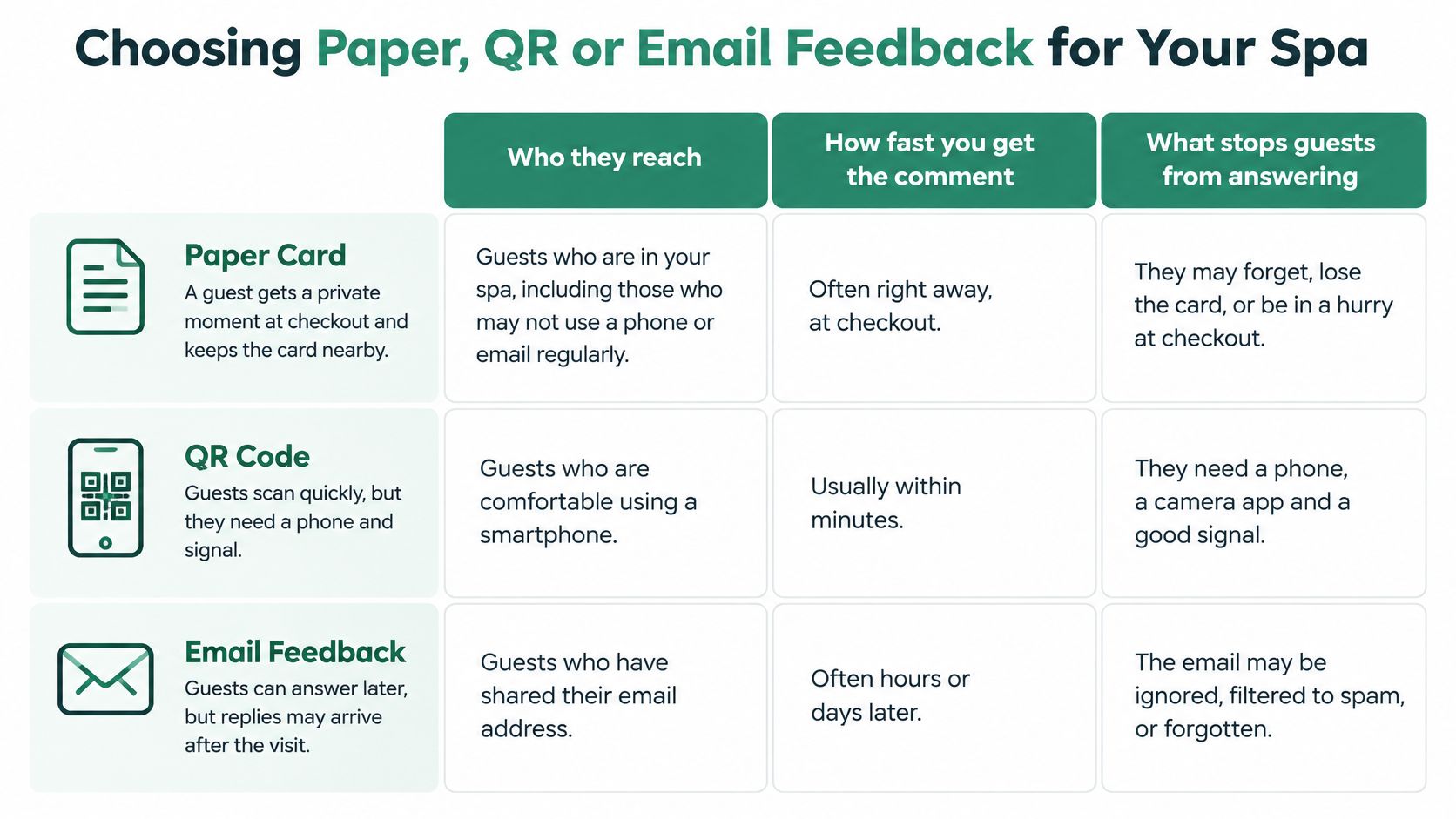
A paper card preserves the guest's handwriting, but staff must copy comments accurately before sorting them. A private QR form avoids that work and can offer anonymous submission. Poor signal, a flat battery or reluctance to use a phone can still stop a response.
Email allows more detail and distance from the desk. It also competes with everything else in the guest's inbox. A long questionnaire shouldn't replace a short, accessible checkout option.
Separate private feedback from public reviews
A QR code landing page can give guests a clear destination, but its purpose must be obvious. A private feedback form and a public review page aren't interchangeable.
HolaQR is a free QR review page that displays in each guest's language, with direct review buttons for Google, TripAdvisor and Facebook, and a code that never expires. Guests scan with their phone camera; the page opens in the browser without an app or account. Posting a review may still require signing in to the chosen platform. Its focus is public reviews, so a separate private complaint route remains necessary.
For a Google-only option, Google's Business Profile guidance provides a review link and QR code through Read reviews, then Get more reviews; the code is generated in a computer browser, not on a mobile device. Place it at the counter or in a guest folder. Whichever route is chosen, every guest should receive the same invitation, without screening by satisfaction.
How to Build and Place Your Comment Card
Placement matters as much as wording. A card beside the payment terminal is convenient, but not if another guest can read every answer. The best position gives guests an obvious place to start and a discreet place to finish.
Prepare the card and the desk
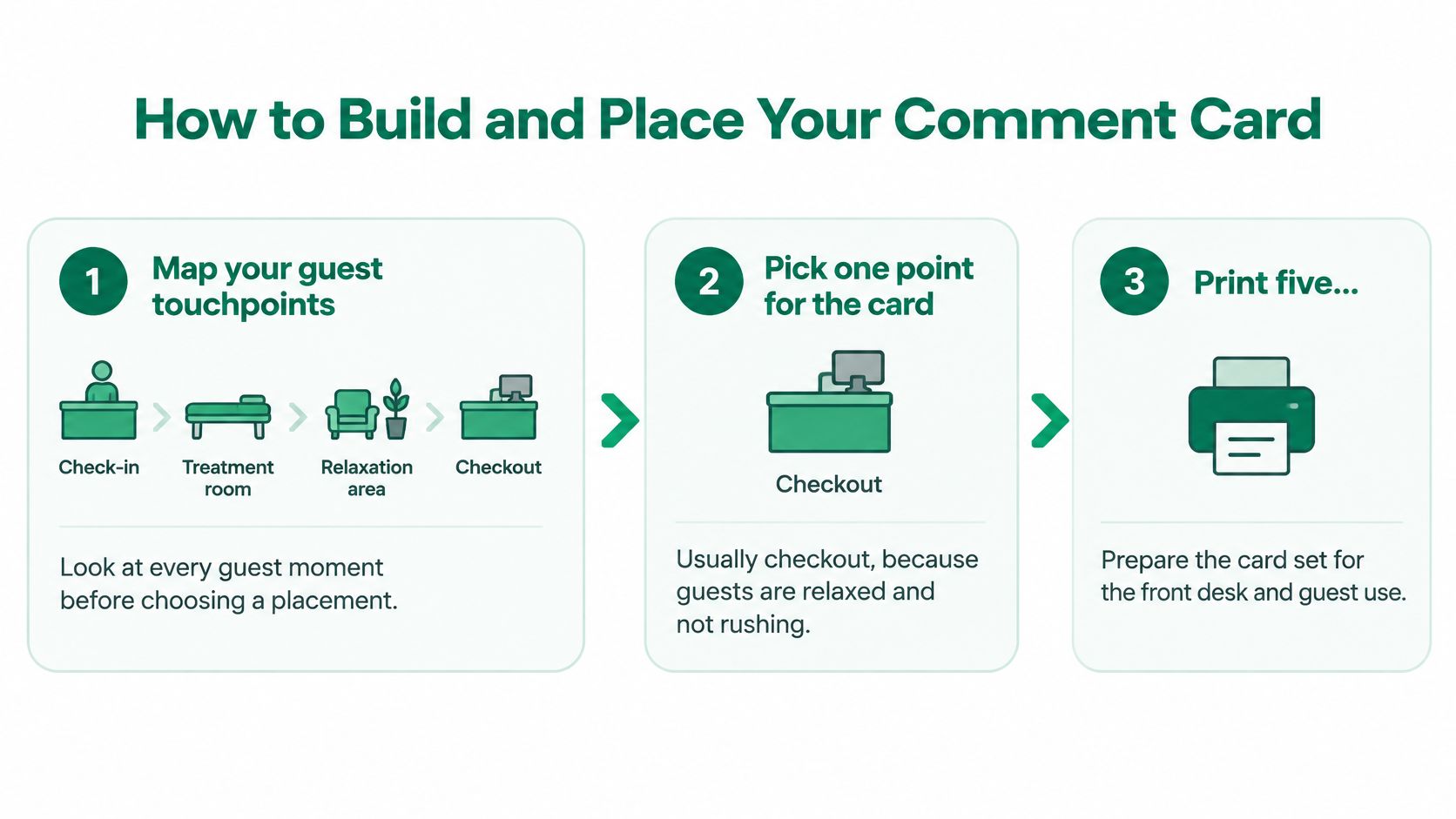
Map the guest's route. Check reception, the treatment room, the relaxation area and checkout before choosing a position. Checkout usually works best, provided the guest isn't juggling payment, bags and transport.
Keep the printed card short. Use five or six prompts on one side, with a brief comment line. A clearly labelled scale suits ratings; yes-or-no answers suit factual questions about prices or explanations.
Explain the boundaries. Add a plain note stating that completion is optional, answers can be anonymous, and comments aren't published automatically. Keep this readable rather than hiding it in tiny print.
Provide a private manager contact. Print the reception email address or telephone number and explain how to request a manager. A guest with a serious concern shouldn't have to describe it aloud at a busy desk.
Check the language. Remove idioms, abbreviations and words such as exceptional. For translated cards, have someone fluent check the meaning, including which end of a rating scale is positive.
Set up the collection point. Put cards and working pens beside a closed collection box at the exit desk, not at the treatment-room door. Staff should offer the card consistently, rather than deciding who looks likely to give praise.
Schedule collection and storage. Check submissions during each shift, then empty and date the weekly batch on Friday for recordkeeping. Keep completed cards somewhere guests and unrelated staff can't browse.
Test the setup during checkout
The manager should walk through checkout carrying a bag and a phone. If completing the card requires balancing it on the payment terminal, add a writing surface away from the queue. If the box opening exposes earlier cards, replace the box.
Practical check: A guest should be able to submit a criticism without handing it directly to the person being criticised.
Similar placement choices arise with a restaurant QR code: visibility helps, but interrupting a meal or crowding a payment point doesn't. In a spa, avoid signs that draw attention to sensitive feedback in a shared relaxation room.
A working setup is ordinary and reliable: a card in every checkout stack, a pen beside it, and a box that receives comments steadily. Reception should also know who replaces supplies before they run out.
How to Triage Feedback During the Visit and After Checkout
A complaint raised before departure offers a chance to help immediately. A card read after checkout needs a clear response owner. Neither should sit untouched until a monthly spreadsheet review.
In a 2025 survey of more than 1,400 U.S. salon and spa consumers, 45% named wait times as their top frustration, while more than 8 in 10 believed businesses should respond to negative reviews, according to Spa Business. Those findings make delays and unanswered complaints useful priorities, not reasons to treat every comment as an emergency.
Sort by urgency
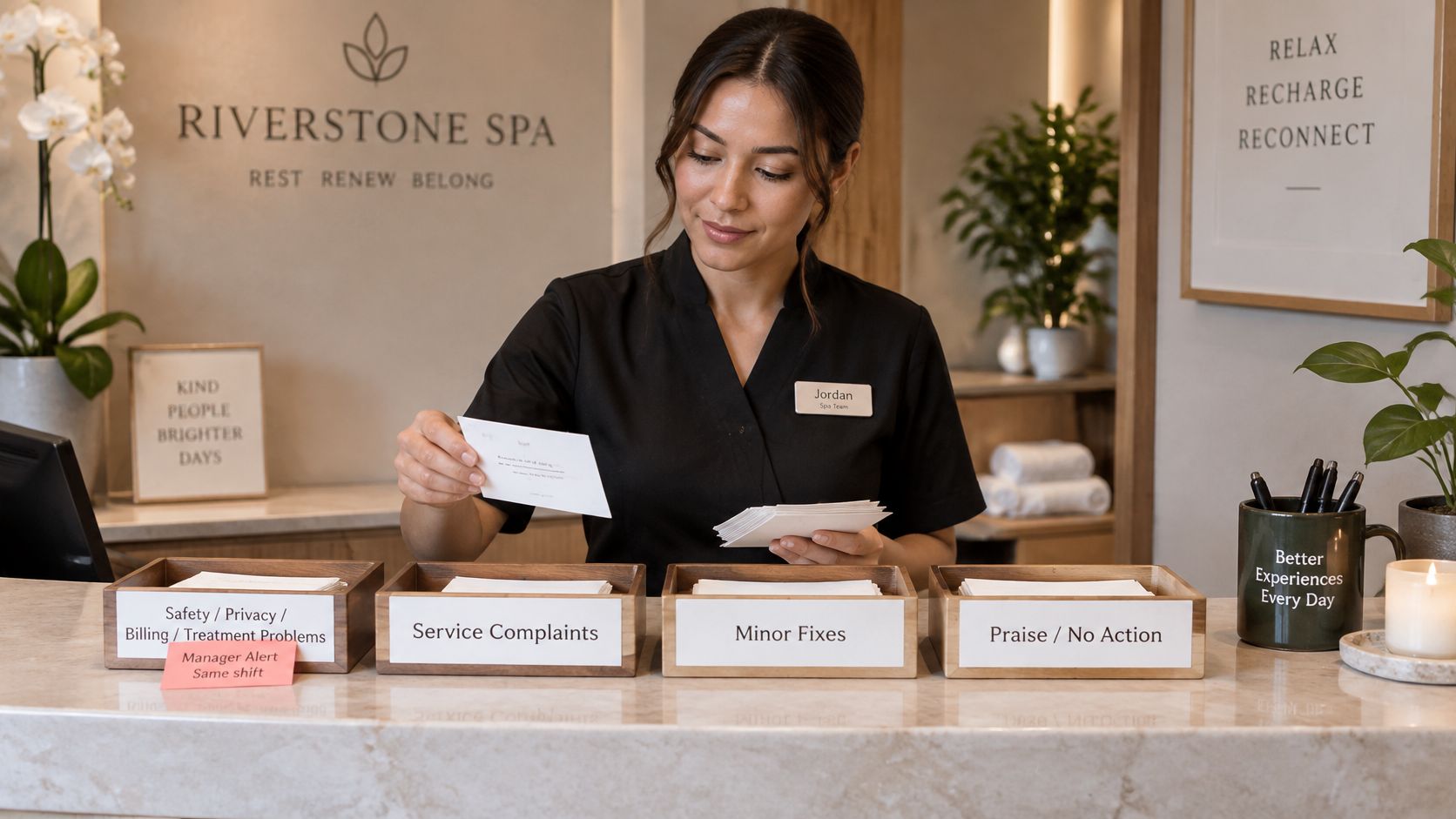
- Safety, privacy, billing or treatment problems: Alert the manager immediately, within the same shift. During the visit, move the conversation somewhere private and address any ongoing risk before discussing paperwork.
- Service complaints: Assign a named person to acknowledge the concern that day. A late therapist or dismissive receptionist needs a specific response, not a stock apology.
- Recurring issues: Bring delays, noise and overcrowding to the weekly review. Compare service times and locations before choosing a fix.
- Positive comments and suggestions: Share praise with the relevant team member. Record useful suggestions with an owner, rather than leaving them attached to a compliment.
Match the reply to the channel
Anonymous feedback can guide an investigation, but staff can't promise a personal reply without contact details. Private complaints need a private response. Public reviews require separate handling, without revealing treatment details or sensitive information.
Guidance on responding to customer service reviews can support public replies, but a guest should never have to post publicly to get help. A serious concern must have a direct route to management regardless of whether a review exists.
Close the loop with what changed. For example, a manager might explain that booking confirmations now list optional extras separately. If no change is possible, explain the reason calmly rather than implying that every request will be accepted.
Every card gets a named owner and a reply date. For anonymous cards, record an internal action deadline instead.
Metrics That Show Whether Your Cards Work
The number of returned cards means little without the number of eligible treatments. In a hypothetical example, 30 completed cards from 40 treatments gives a 75% response rate, while 30 from 120 gives 25%. The same stack of paper can represent very different reach.
The calculation is completed cards divided by eligible treatments, multiplied by 100. Define eligibility consistently, and don't count only the guests whom reception happened to ask.
Comment card metrics to track
| Metric | How to calculate | Healthy sign |
|---|---|---|
| Completion rate | Completed cards divided by eligible treatments, times 100 | Rising over the season |
| Mean satisfaction score | Sum of all overall satisfaction scores divided by cards answering that question | Stable or rising month to month |
| Low score share | Cards scoring 1 or 2 divided by all cards with that score answered | Falling or steady |
| Repeat issue rate | Issues that appear more than once divided by all issues | Falling after fixes |
| Median closure time | Middle value of days from complaint to reply | Short and steady |
Use the same overall satisfaction question for the mean. Don't mix a cleanliness rating with a treatment-explanation rating and call the result overall satisfaction. Define low scores and issue categories before comparing reporting periods.
Read the measures together
The International SPA Association's November 2016 Snapshot Survey found that 66% of surveyed resource partners used follow-up phone calls, while 24% used electronic in-house customer surveys. Cards belong within a wider listening system, not as a complete measure of guest opinion.
More completed cards with a steady low-score share can mean better reach, not worse service.
A higher average isn't enough if the same privacy complaint keeps returning. Likewise, a fast acknowledgement doesn't prove that the underlying problem has been resolved; track the promised action separately.
Once a week, count submissions, calculate completion, list the three most repeated comments and assign a fix to each. Keep handwritten wording intact when entering comments into the tracking sheet.
Mistakes That Make Comment Cards Useless
A full box doesn't prove that spa comment cards are useful. Poor questions can produce praise without identifying problems, while poor handling can make guests regret answering.
- Leading prompts encourage approval. Replace language about loving a massage with a neutral question about the treatment.
- Combined questions hide the cause. Ask about staff courtesy and room cleanliness separately so a low score has a clear meaning.
- Missing context prevents action. Offer optional fields for the service, location and approximate visit time, without forcing guests to identify themselves.
- Ratings shouldn't control review access. Keep the public review opportunity available regardless of the private card score.
Never attach a reward
Tripadvisor's incentive policy prohibits incentives tied to reviews, including a free restaurant drink, free hotel Wi-Fi, a bill discount, a room upgrade, a raffle or contest entry, and rewards for employees who obtain reviews; the prohibition applies regardless of the rating requested, and penalties can include review removal and loss of Tripadvisor award eligibility.
Calling the reward a thank-you doesn't change its connection to the review. Staff targets shouldn't encourage pressure at checkout either.
Asking guests for a review is allowed. HolaQR sends every guest to the same review window, never offers rewards for reviews and never chooses which guests are asked.
The practical rule is straightforward: ask every guest after the visit, offer nothing in return, and don't ask only those who seem pleased.
Put Your First Comment Card on the Counter Today
Choose a route this week rather than waiting for a perfect design. A paper card can start collecting private feedback at checkout. A public-review QR code serves a different purpose and should sit alongside a clearly identified private contact option.
- Choose five prompts. Select questions that match problems the manager can investigate and fix.
- Prepare the exit desk. Put the card, pen and collection box within easy reach, or display the chosen QR code clearly.
- Brief reception. Give every guest the same calm invitation, including anyone who appeared unhappy. Participation remains optional.
- Set Friday's review. Count cards, calculate completion and assign actions. Safety and privacy concerns must receive same-day attention when discovered, not wait for Friday.
For owners who want a public-review option without building a form, HolaQR is free and doesn't require a credit card. Guests can scan its code from the owner's phone screen today, with nothing to print first. Keep the separate private complaint route visible.
Put the first card or code at the desk today and name the person responsible for checking responses. The question for tomorrow is concrete: which guests will receive an invitation this week, and what will staff do with their answers?